New
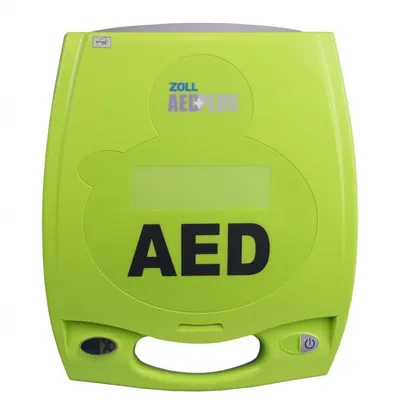
ZOLL AED Plus automated external defibrillator
Automated external defibrillator for lay users; rectilinear biphasic waveform, up to 200 J, one-piece CPR-D-padz electrode, LCD screen.
Price on request
Add this device to your quote list to request its price.ТОО "FSA KZ (ФСА КЗ)", Almaty, Kazakhstan, BIN 210940036794
- Brand
- Zoll
- Category
- Defibrillators
Description
The Zoll AED Plus external defibrillator was designed for people without medical training. It therefore works automatically, and even a random bystander can help a patient on the spot. This device is an ideal embodiment of a "public access" defibrillator that not only restores the heart rhythm but also provides real help.
The unit is equipped with a quality screen, a clear interface and voice guidance. All this makes it possible to follow clear instructions and avoid mistakes when working with the AED. In addition, it uses D-Pad, a patented electrode technology that evaluates the correctness of compressions and, if necessary, asks the rescuer to push softer or harder.
Advantages of the ZOLL AED Plus defibrillator
Zoll rectilinear biphasic waveform.
Zoll is a company that developed its own rectilinear biphasic waveform. It is very effective against ventricular fibrillation, making it an almost ideal choice for patients with increased inter-electrode impedance. The waveform is protected against strong current fluctuations, so it maintains its shape even when the patient's chest offers resistance. This not only allows more effective help but also reduces the risk of myocardial injury many times over. The Zoll biphasic waveform uses a maximum energy of 200 J, whereas a conventional waveform uses 360 J. As early as 2005, the European Resuscitation Council stated that the Zoll waveform is as effective as a conventional waveform, but safer.
Voice and text CPR prompts.
Thanks to its excellent interface and voice prompt system, the Zoll AED Plus gives the person using the defibrillator instant feedback. These prompts make the rescuer correct the most common CPR mistakes, such as insufficient compression rate and inadequate compression depth during cardiopulmonary resuscitation. The defibrillator has a Russian voice option, so anyone will understand when to push harder or softer and when their compressions are ideal. There is also a metronome built into the electrode pad. Its purpose is to allow a person without proper skills to deliver 100 compressions per minute.
A one-piece electrode pad is better than two separate electrodes.
Automated external defibrillators often share one common drawback: the rescuer must be able to place two electrodes correctly on the patient's body. Not every person without CPR experience can manage this. Zoll replaced the electrodes with a one-piece pad that is very easy to apply to the patient. The compression point is marked so that it is practically impossible to position it incorrectly. In addition, this pad (CPR-D-padz) has a patented service life of about 4 years. Among disposable electrodes, this is unprecedented.
Standard long-shelf-life lithium batteries for economy and user convenience.
The Zoll AED Plus is also economical. The device uses fairly inexpensive lithium batteries that can last about 5 years. This means they need replacing even later than the electrode pad. New batteries are easy to buy, as they are very common.
Built-in LCD display.
The person using the defibrillator can optionally display ECG lead II on the screen. In addition to the electrocardiogram, the display shows a resuscitation time counter, the number of shocks delivered and a detailed compression depth diagram.
Scope of delivery
- AED Plus defibrillator
- Black carry bag
- CPR-D-padz: one-piece self-adhesive electrode pad with a sensor for monitoring compression depth and rate, resizable for large patients. For adult patients.
ZOLL AED Plus defibrillator technical specifications
- Defibrillation waveform
- biphasic rectilinear-trapezoidal
- Energy selection
- automatic, pre-programmed selection (120 J, 150 J, 200 J)
- Charging time
- less than 10 s
- Operation and battery charge self-test
- 1. continuously during operation; 2. every seventh day (in storage)
- Patient impedance measurement range
- 0-300 Ω
- Battery capacity
- 300 shocks or 1.5 hours of continuous monitoring/defibrillation
- Size (height, width, length)
- 13.3 cm × 24.1 cm × 29.2 cm
- Weight
- 3.1 kg